
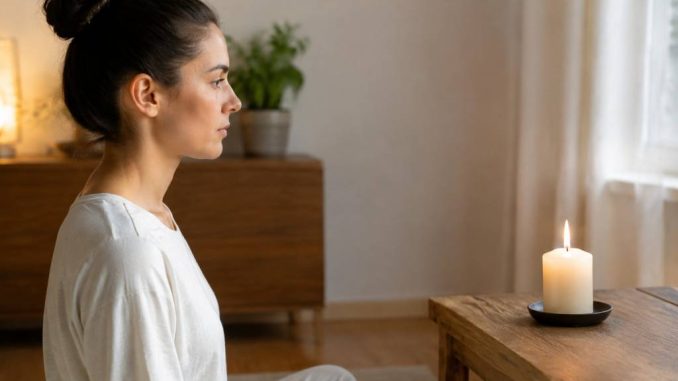
Your attention is an athlete. It accelerates, changes direction, gets distracted, and sometimes refuses to follow instructions. Trataka meditation is a way to train it—one steady gaze, one quiet breath, one moment at a time.
Often described as “candle gazing,” Trataka is a traditional yogic concentration practice. You focus your eyes on a single object, usually a flame, then close your eyes and observe the image that remains in your mind. It sounds simple. In practice, it can be surprisingly intense. The mind may sprint through unfinished tasks, dinner plans, old conversations, and tomorrow’s worries before it finally settles.
That is precisely why Trataka can be useful. It creates a clear target for your attention and gives you a practical way to develop focus, calm, and self-awareness. Here is how to practise it safely, what benefits you may notice, and how beginners can build a sustainable routine.
What is Trataka meditation?
Trataka comes from the Sanskrit word often translated as “gazing” or “looking steadily.” It is traditionally associated with hatha yoga and is considered both a concentration technique and a cleansing practice for the eyes and mind.
The most familiar form involves gazing at a candle flame without blinking for as long as is comfortable. After this external focus, you close your eyes and observe the internal image of the flame. This creates two stages:
- External Trataka: directing your visual attention toward a physical object.
- Internal Trataka: observing the mental image or afterimage of that object with closed eyes.
Although a candle is traditional, you can also use a small dot on a wall, a flower, a symbol, or another simple object. The key is not the object itself. The key is steady attention without forcing your body into unnecessary tension.
Why practise candle gazing?
Modern life trains the opposite skill. We jump between notifications, screens, conversations, work tabs, and background noise. Trataka asks for one task only: stay with what is in front of you.
That makes it especially relevant for athletes, busy professionals, students, and anyone whose attention feels scattered. A runner does not improve by sprinting in ten directions at once. The same principle applies to concentration. Focus becomes stronger through repeated, deliberate practice.
Trataka may help you develop:
- Better sustained attention
- A calmer transition into meditation
- Greater awareness of mental distractions
- Improved relaxation before sleep
- A stronger sense of visual and mental presence
- More patience with uncomfortable or restless moments
Some practitioners also report less eye strain and a clearer mind. These experiences can be real and valuable, but Trataka is not a medical treatment for vision problems, insomnia, anxiety, or any other condition. Think of it as a concentration and mindfulness practice—not a replacement for professional care.
Potential benefits for beginners
Sharper concentration
The first obvious challenge is keeping your attention on the flame. Your eyes may wander, and your mind will almost certainly wander. Each time you notice this and gently return to the object, you are doing the actual training.
This is similar to strength training. The repetition is not wasted when you lose focus. The return is the repetition. Over time, you may find it easier to remain present while reading, working, training, or listening to another person.
A quieter mind
Trataka does not switch off thoughts like a magical remote control. Instead, it gives thoughts less room to dominate. You observe the flame, notice an idea, and return to the flame. The mental noise may gradually lose its grip.
For someone who arrives at meditation carrying the energy of a hectic day, this visual anchor can be easier than beginning with eyes closed. There is less empty space for the mind to fill.
Support for evening relaxation
A short, gentle practice may help create a clear boundary between daytime activity and nighttime rest. The slow rhythm of gazing, closing the eyes, and breathing calmly can become a useful wind-down signal.
However, candlelight is still light. If you practise close to bedtime, keep the session comfortable and avoid staring intensely for too long. If your eyes feel tired, stop. Relaxation should not feel like an endurance test.
Greater self-awareness
Trataka reveals your habits quickly. Do you become impatient after ten seconds? Do you tense your jaw? Do you chase every thought? Do you try to “win” the practice by refusing to blink?
These observations are not failures. They are information. The practice helps you notice how you respond to discomfort, boredom, and distraction. That awareness can transfer into sport, work, and everyday decisions.
How to practise Trataka safely
Choose a quiet room where you will not be interrupted. Dim lighting works well, but the room should not be completely dark. Place a candle on a stable surface at eye level, roughly an arm’s length away. The flame should be still, so avoid fans, open windows, and busy air-conditioning vents.
Sit on a cushion, yoga mat, or chair. Your spine should be upright but not rigid. If sitting on the floor makes your hips, knees, or back complain, use a chair. There is no medal for suffering through poor posture.
Follow these steps:
- Light the candle and place it at eye level.
- Sit comfortably with your shoulders relaxed and hands resting on your thighs.
- Take several slow breaths through the nose.
- Gaze softly at the brightest part of the flame, usually near the wick.
- Keep your face relaxed. Do not tighten your forehead or jaw.
- Blink naturally when needed, especially as a beginner.
- When your eyes feel tired or watery, close them gently.
- Observe the afterimage behind your closed eyes without trying to control it.
- When the image fades, bring your attention back to your breathing.
- Open your eyes slowly and sit quietly for a few moments.
Start with five minutes. That is enough. You can gradually build toward 10 or 15 minutes if the practice remains comfortable. Consistency matters more than duration. Five focused minutes several times a week will serve you better than one heroic session that leaves your eyes irritated.
The right way to use the afterimage
After closing your eyes, you may see a bright or coloured image of the flame. This is a normal visual afterimage created by the eyes and brain. It may move, change shape, or disappear quickly.
Do not chase it. Do not strain to keep it visible. Simply watch it as you would watch a cloud passing across the sky. If there is no afterimage, that is fine too. Return to the sensation of breathing or the gentle darkness behind your eyelids.
This internal phase is where the practice shifts from visual concentration to mental concentration. The physical flame is no longer doing all the work. You are learning to hold an image, then to remain present when the image changes.
Common mistakes that reduce the benefits
Forcing yourself not to blink
Traditional descriptions sometimes emphasise an unbroken gaze. Beginners often interpret this as a battle against blinking. That approach can produce dry, painful, or strained eyes.
Use a soft gaze and blink when necessary. Over time, your comfort may improve naturally. There is no performance score attached to your tear ducts.
Staring too intensely
Concentration is not the same as aggression. If your brow is furrowed and your eyes feel locked onto the flame, you are probably working too hard. Imagine looking at the flame with friendly curiosity rather than trying to overpower it.
Practising in an unsafe environment
A candle is an open flame. Keep it away from curtains, paper, loose clothing, children, pets, and anything else that can catch fire. Never leave it unattended, even for a short meditation session. Extinguish it fully when you finish.
Expecting instant calm
The first sessions can feel restless. You may notice more thoughts than usual because you are finally paying attention to them. That does not mean Trataka is making your mind busier. It may simply be making the existing activity easier to see.
Turning practice into another challenge to conquer
Athletic discipline is powerful, but meditation requires a slightly different gear. You do not need to push through every sensation. The goal is steady awareness, not maximum discomfort. Treat the session as skill development, not a test of toughness.
Trataka variations to explore
Once you are comfortable with candle gazing, you can experiment with other objects. A small black dot on a white sheet of paper is a simple option and may be easier to use during the day. A flower can add a softer, more natural visual focus. Some people choose a meaningful symbol or a small geometric shape.
You can also practise without a candle if you have light sensitivity, share a space with others, or simply prefer a screen-free daytime routine. The method stays the same: select one object, observe it steadily, close your eyes, and notice the mental image or sensations that follow.
For a more calming variation, combine Trataka with slow breathing. Inhale for a comfortable count of four and exhale for a count of six. Never force the breath or hold it if that creates tension.
When to avoid or modify the practice
Stop immediately if you experience sharp eye pain, persistent headache, dizziness, nausea, unusual visual symptoms, or significant discomfort. Temporary watering or mild fatigue can happen, but pain is a clear signal to step back.
Use extra caution or ask an eye-care professional for guidance if you have an eye condition, recent eye surgery, severe dry eye, migraines triggered by light, photosensitivity, or another visual concern. People with neurological conditions that are sensitive to flickering light should also avoid experimenting without professional advice.
Never practise while driving, operating equipment, or in any situation where your attention needs to remain on safety. Trataka belongs in a quiet, controlled setting.
A simple seven-day beginner plan
Would you like a practical starting point? Try this light, progressive schedule:
- Day one: Sit quietly for three minutes and observe the flame. Blink naturally.
- Day two: Practise for five minutes, finishing with one minute of closed-eye breathing.
- Day three: Repeat five minutes and notice where tension appears in your face or shoulders.
- Day four: Extend the external gaze to six minutes if your eyes feel comfortable.
- Day five: Add two minutes of observing the afterimage or inner darkness.
- Day six: Practise for eight to 10 minutes with a soft, relaxed gaze.
- Day seven: Choose the duration that felt most sustainable and repeat it without forcing progress.
Keep a brief note after each session: How long did you practise? How did your eyes feel? Was your mind restless, calm, or somewhere in between? This turns vague impressions into useful feedback and helps you adjust intelligently.
Making Trataka part of your routine
The best time to practise is the time you can repeat. Some people prefer early morning, before messages and responsibilities begin. Others use Trataka after training, when the body is warm but the nervous system needs to downshift.
Keep the setup easy. Store a candle, lighter, and small cushion in one place. Set a gentle reminder. Begin before the practice feels necessary—not only on stressful days. Like mobility work or strength training, the benefits build through regular repetition.
After a few weeks, you may notice small but meaningful changes: less frantic scrolling, an easier return to a task, more patience during a difficult workout, or a smoother transition into rest. These are not fireworks. They are signs that your attention is becoming more available.
Trataka is a quiet discipline with a clear target. Sit down, light the flame, and give your attention one job. When the mind runs off—as it will—bring it back without drama. One return, then another. That is the practice, and that is where the real strength begins.